Avoid the trap: how greenwashing puts startups at risk
Why should early-stage startups care about greenwashing? The risks go beyond bad press: vague or unverified claims can damage trust, delay funding, or even lead to legal consequences. With the right tools and guidance, founders can communicate sustainability clearly and credibly from the start.
- Sofie
- 6 min read
In the early stages, when the value proposition and business model are still being shaped, it is easy to make claims that are vague, overstated, or lack documentation.
These mistakes are rarely deliberate, but they can damage trust, slow down funding, and lead to regulatory or reputational consequences. As a university-based entrepreneurship centre, we focus on giving startups the tools and coaching they need to navigate sustainability in a way that is realistic, clear, and matched to their stage. Through our sustainability-focused offerings and ongoing coaching, we help founders avoid greenwashing and build a business that can stand up to scrutiny.
What is greenwashing?
The term was coined in 1986 when environmentalist Jay Westerveld criticised hotels for promoting towel reuse as an environmental effort, while really aiming to cut costs. Today, greenwashing refers to the gap between what companies claim and what they actually do on sustainability. It includes false, vague or unproven claims – or omitting negative impacts while promoting a green image.
There is no single definition, but these are among the most common types identified.¹
- Falsely stating a product is certified
- Claiming recycled content without proof
- Using vague terms like “eco-friendly” or “green”
- Promoting features that are legally required (e.g. “CFC-free”)
- Highlighting one benefit while ignoring harms
- Using misleading or fake eco-labels
The reality of an early-stage founder
For early-stage startups, sustainability is often sidelined in favour of growth and product development – but overlooking it can have serious consequences. Greenwashing is no longer just a reputational risk for big corporations.
Andreas Rasche, Professor of Business in Society at the CBS Centre for Sustainability and Associate Dean for the CBS Full-Time MBA Programme, notes that smaller companies are not immune: business partners, investors, and regulators are starting to scrutinise even early-stage claims. While media and NGOs may focus on larger brands, startups face pressure from within the ecosystem – through due diligence, supply chain requirements, and investor expectations.
For founders genuinely motivated to create positive impact, the line between ambition and overstatement can blur. This is where greenwashing becomes a hidden risk: exaggerating impact or using vague terms without supporting data can lead to legal, financial, and strategic setbacks.
“Overstating your impact might feel harmless in the early days, but it can quickly become a credibility risk – or even a legal one.”
EU regulation is beginning to define what is acceptable in sustainability claims. The EmpCo Directive (Empowering Consumers for the Green Transition) has been adopted and will apply from 27 September 2026 after national implementation. It bans vague claims like “eco” or “environmentally friendly” and prohibits offset-based “climate neutral” claims. The Green Claims Directive, by contrast, remains on hold. While exemptions for micro-enterprises have been debated, the direction is clear: claims must be evidence-based. Even simplified rules will require basic awareness and compliance from smaller firms.
Startups don’t need the same systems as global corporations, but they do need to understand where to begin. As Rasche stresses, sustainability should not become an overwhelming burden. It should be addressed in small, concrete steps. Getting the fundamentals right from the start can build credibility, reduce risk, and open doors to funding. In a competitive landscape, sustainability is no longer a “nice to have”, but part of building a resilient, investable business from day one.
How we help startups avoid greenwashing
At CSE, we work with founders at various stages and different sustainability awareness. Some come with deep knowledge. Others are just starting to think about the topic. Our role is to meet each team where they are – and help them understand what sustainability means in their specific business context.
We make greenwashing risks tangible and relevant. That means showing how a claim could mislead, and what’s needed to back it up. Avoiding greenwashing isn’t about legal perfection, but about building a solid foundation of transparency and responsibility.
The seven sins of greenwashing
We use this framework, developed by TerraChoice, as one of the tools to help founders reflect on their messaging, spot risks and build more honest and effective communication. It’s practical and easy to work with, especially in early-stage coaching sessions. It helps founders ask: what am I saying, can it be misunderstood, and what evidence do I have?
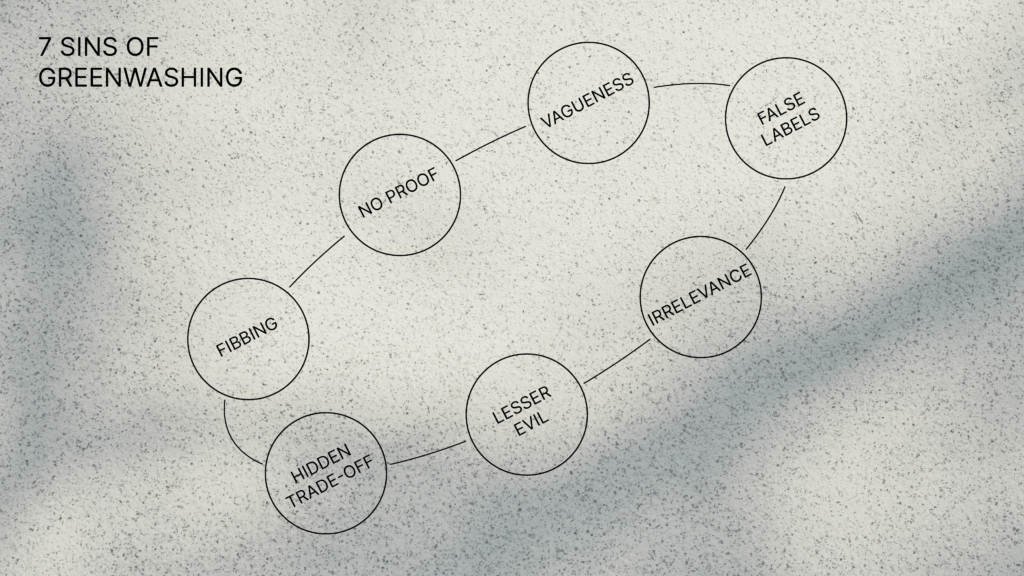
The 7 Sins of greenwashing, developed by TerraChoice. Own illustration.
The seven sins of greenwashing include:
- No proof. Do I have accessible, transparent, and supporting documentation or a third-party certification to support my claim?
- Vagueness. Can my claim be interpreted in a misleading way or be misunderstood?
- Worshipping false labels. Is the label I use based on a certification scheme – or made-up and unofficial?
- Irrelevance. Is the information in the claim true but required by law?
- Lesser of two evils. Am I highlighting a minor benefit while ignoring the bigger problem?
- Hidden trade-off. Is my claim focusing on one positive aspect and omitting others?
- Fibbing. Am I lying?
The Forbrugerombudsmanden’s recommendations
The Danish Consumer Ombudsman’s Quick Guide is an essential tool for understanding the legal side of sustainability communication in Denmark. It explains what can be said, how it should be documented, and how to avoid exaggeration.
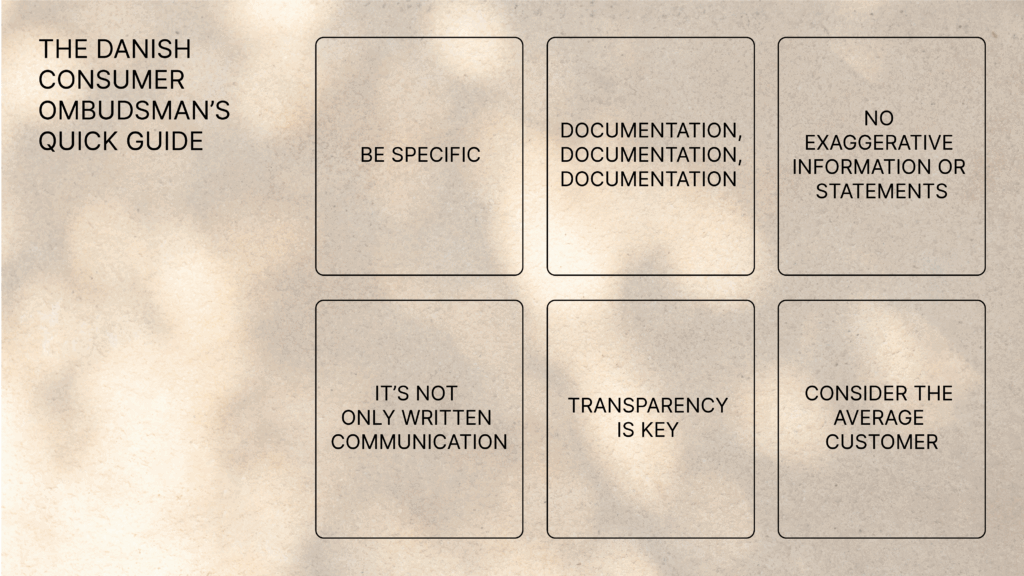
The Danish Consumer Ombudsman gives guidance for environmental marketing to help businesses avoid greenwashing. Own illustration.
- Be specific – no fluff or vague statements
- Documentation, documentation, documentation – confirming the actual conditions
- No exaggerative information or statement, e.g. “We’re saving the planet” vs. “We organise 1 beach-cleaning event per month at the local beach”
- It’s not only written communication – it is everything
- Transparency is key
- Consider the average customer/user
We use it in coaching to help startups distinguish between brand messaging and factual claims. The guide also highlights how images, colour schemes, or symbols can mislead — even if the wording is technically fine. Our team also acts as a contact point if founders need help applying the guide.
Training our own team
To give good guidance, we need to keep learning ourselves. All staff at CSE receive training in sustainability fundamentals. Business developers go through an in-depth sustainability training to sharpen their skills and use relevant coaching tools.
This means we’re not only passing on best practices, we’re building shared understanding across the centre. The aim is not to make everyone a sustainability expert, but to create a baseline of literacy and the ability to ask better questions.
Embracing complexity
We know that sustainability can feel like “one more thing” on a long list of startup challenges. But overlooking it early can be far more costly later – whether that’s legal exposure, lost funding, or damage to your brand.
Sustainability isn’t about being perfect. It’s about being clear, honest and prepared. At CSE, we believe this starts with small, practical steps; matched to where the startup is today, but with an eye to where it wants to go.
We offer coaching, tools, and programmes to help founders develop ventures that are both resilient and responsible. And we train ourselves, so we can support others better.
¹ Rasche, A. (2025). ‘The concepts of greenwashing and greenhushing’.
Photography: Yanhao Fang, Ramses Cervantes, Toa Heftiba via Unsplash
Curious about how we work with founders and business developers? Explore our offerings for students and apply for CSE here.